Why Grafioschtrader (GT) exists
For several years I used a portfolio management application that met my initial needs. Over time I realised that transaction and custody costs have a considerable impact on the overall return of a portfolio. So I looked for different online brokers that offered the most favourable trading conditions for my investments. To this day only a combination of several trading platforms meets my needs. As a Swiss investor there is the additional aspect that, sooner or later, investments are made in foreign currencies.
Over time you lose track of how much is invested in what. I thought it did not have to be this way and, as a software developer, I threw myself into the Grafioschtrader adventure. With GT I now have an overview of the held positions, performance and account balances per portfolio or accumulated across all portfolios.
Try out GT
You can try out GT via the GT app. In addition there is a user manual and a YouTube channel. Create your own account or use one of the following existing accounts:
| E‑mail | Password | Language |
| gt1@grafioschtrader.info | gt1 | German |
| gt2@grafioschtrader.info | gt2 | German |
| gt3@grafioschtrader.info | gt3 | German |
| gt4@grafioschtrader.info | gt4 | German |
| gt5@grafioschtrader.info | gt5 | English |
| gt6@grafioschtrader.info | gt6 | English |
What GT can do
- The software is free and open source: GT is released as open source and can be found on GitHub.
- Multi-tenancy: GT can be operated for a group of investors or in single-user mode.
- Web application: GT is a web application and delivers the clearest results in a desktop web browser.
- Several portfolios with currency accounts: Reproduction of several portfolios with one or more securities accounts and one or more bank accounts.
- Multiple currencies: Trading of securities in different currencies.
- Trading since the turn of the millennium: Basic support for historical price data from the year 2000. Please note that obtaining price data for securities that are no longer traded may be a problem.
- Different financial instruments: shares, bonds, ETFs, securities without price data, short ETFs, CFDs, forex.
- Price data from various sources: Historical and intraday prices are obtained from various freely accessible data sources.
- Import of transactions: Import of single or multiple PDFs with securities transactions. Account transactions can also be loaded via CSV file.
- Standing orders: Recurring entries such as savings plans as well as regular deposits and withdrawals.
- Watchlists with price history: Watchlists with charts (line, OHLC and candlestick diagrams) and individual technical indicators.
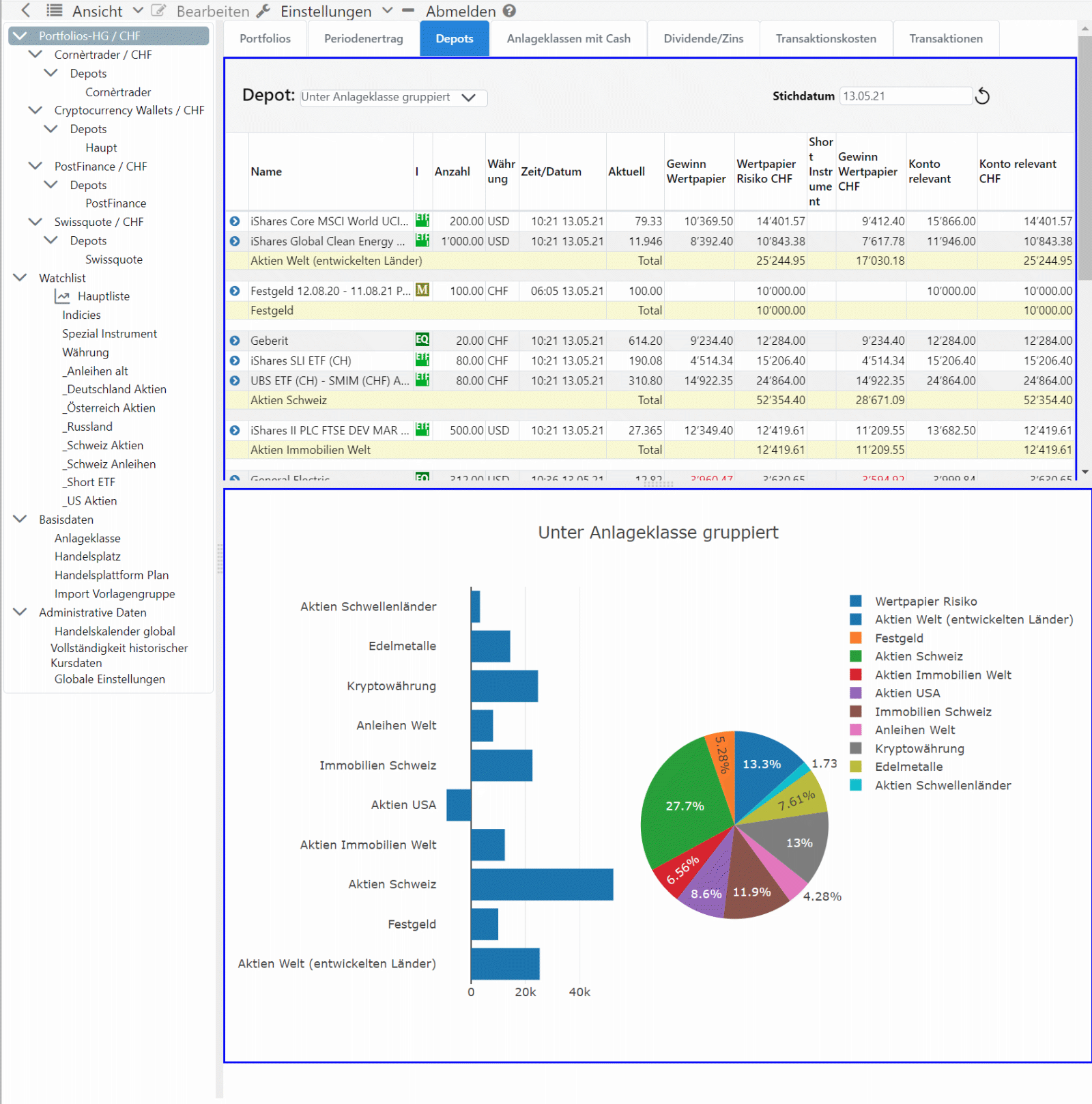
- Evaluations by asset class: Evaluations according to the common asset classes such as shares, bonds, real estate, commodities, etc.
- Evaluations and reports: Performance over freely selectable time periods as well as overviews of dividends and interest and of the transaction costs incurred.
- Correlation matrix: Examination of the correlation between instruments to assess diversification.
- Multilingual: The user interface is available in German and English.
Who GT is suitable for
GT is an attempt to reproduce portfolios in line with reality, which is why there are accounts just like at your online broker. Every entry is linked to a cash account, so the entries are reproduced in line with your trading platform.
- The investor who does not want to entrust their financial data to a non-transparent platform. You can host GT yourself; a Raspberry Pi 4 with 4 GB (possibly also 2 GB) of memory is sufficient.
- A shareholder who wants a history of all their trades. You can view all closed positions at any time.
- The private investor who wants to know how their currency gains develop. The currency gain on the foreign currency accounts is shown continuously.
- The cost-conscious investor who wants to keep an eye on their transaction and custody costs.
- An investors’ club that wants to host its own GT instance and where one member is happy to take care of the technical aspects.
- Investors with several portfolios at different trading platforms. GT provides information per portfolio and can present it in aggregated form.
Who GT is not intended for
Before you waste your time unnecessarily with GT, you should consider the following:
- The day trader lacks real-time prices.
- Investors who want to manage their trading detached from cash accounts.
- The investor who has only one portfolio at a single online broker and for whom that broker’s evaluations are sufficient.
- There are investors who create portfolios according to certain criteria, such as a dividend portfolio. GT does not support such an approach. On the contrary, the aggregated evaluation across real portfolios at different trading platforms is the goal.
- GT will not provide support for supposedly real public portfolios from users. The point of these possible fake portfolios escapes the developer of GT. Most importantly, a portfolio is individual and hopefully strongly influenced by the life circumstances of the respective investor. Reducing this whole to a few figures and charts is nothing other than disinformation.
Where GT does not work
GT is definitely not an all-in-one wonder solution:
- For investors who want to manage transactions with GT before the year 2000. GT consistently implements two-digit years.
- In GT the combination of the ISIN and the currency of an instrument is unique. So the same ETF in EUR cannot be recorded, for example, for both the Frankfurt and Stuttgart trading venues.
- For investors who want to assign an instrument to a sector/theme and countries/regions at the same time.
- For investors from Switzerland, Germany or the USA who need a Valoren no., German securities identification number (WKN) or CUSIP number. GT uses the International Securities Identification Number ISIN and the not always unambiguous tickers/symbols.